

As I mentioned earlier, after Austin, I headed to the famous Sin City. To be honest, I had been waiting for this for quite a while, as I didn't travel here until I turned 21. Otherwise, there's simply nothing to do here. I prepared for the trip in advance (as I do for all my trips), so I booked a motel. Those who have read all my blogs carefully might be surprised now, as out of all the cities I've visited, this is the first motel I've booked. Well, actually, there was one, but it was just for show. I canceled the booking later anyway. Otherwise, over these years, I've had to sleep in airports, planes, trains, cars, at friends' places, through Couchsurfing, in dorms, and in hostels. The last two are the only ones I've had to pay for :) Let me remind those who don't know or have forgotten that a hostel and a motel are different. A hostel is the cheapest option. It's where you're usually put in a room with 4-8 beds. You can re-read my first blog, the part about San Francisco. Although I mentioned there that we were put in a room with some creepy guys (according to my friends' stories), I've read many positive reviews from people who found travel companions and just new friends while staying in a hostel. A motel, on the other hand—where I stayed—is a cheap version of a hotel. You've probably seen them often in movies. They are usually quite typical in appearance: two stories, possibly even with a pool, and many rooms in a row. As soon as I got my visa, I booked one of the cheapest options—Days Inn Las Vegas. I can give a brief assessment that the motel is good overall. The rooms are clean, there is a laundry room, and a small cafe. For 4 nights, I paid $136 + they took $100 from my card as a deposit, which was returned as soon as I checked out. Just a guarantee that I wouldn't cause any trouble. By the way, the rooms were cleaned every day, which was also incredibly pleasing. And the laundry room turned out to be just in time, because when you've been traveling for about 10 days, and walking as many miles as possible, you end up with very few clean clothes. So I had to wash some things. It's worth noting that if you are under 21, many (or maybe even all) motels and hotels won't let you in at all. For example, they checked my passport to make sure I was over 21 before I checked in. So when you book accommodation, check if they have such conditions. As for food... They had a Denny's diner right in the motel. It's one of the American chains of family restaurants/coffee shops that has almost any food, depending on the time of day. They cook pretty well, but the prices are higher than, for example, at some McDonald's. For a good breakfast: a set of any kind of eggs, meat (bacon or sausage), toast, and something of your choice like mushrooms or pancakes + coffee, you'll pay about 15-17 dollars + tips. But on the bright side, black coffee with cream is unlimited in such places. Those who are planning to travel to the USA for the first time and want to book a motel, don't let the price for 4 nights confuse you. I mean, yes, 136 dollars is very cheap. BUT. The thing is, this is normal for Vegas. That's what Vegas lures you with—everything here is very cheap. Almost everything. (Bars and adult bars, by the way, too). But by spending little money on hotels, motels, and hostels, you can, accordingly, blow more money on slots and roulette. It's a trap, sort of. And they are everywhere here, you know? I said in the last part that just by stepping off the plane, you'll already encounter slot machines. You'll want to try it once, then once more, and maybe a hundred is already gone. And there are machines in almost all motels and hotels. Where I lived, by the way, too. Or rather, there was a small casino with its own cashier. But I didn't play. I'm easily susceptible to such things, so I shouldn't sit down. And I advise you all to be careful. You'll blow all the money you earned (or planned to earn), and that will be your trip. Anyway, I arrived
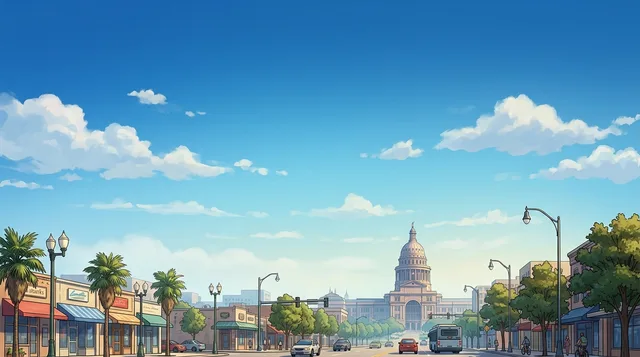
Austin: Guia de viagem, preços e alojamento gratuito · 2026
Austin demands personal wheels the moment you leave the university district, where sparse bus connections make a car or a bicycle essential for daily life.
- Municipal buses and commuter rail lines
- English
- Downtown bike rental stations and community cycling workshops
- English
- Counter-service dining spots and mobile food trailer parks
- English and Spanish
«Can I get this to go?» — Used when ordering meals at casual counters or food trailers.
- 1 dia
- Texas State Capitol, Frost Bank Tower, Lady Bird Lake
- 3 dias
- + Blanton Museum of Art, Main Building, Moody Center
- 7 dias
- + Lake Austin, Austin History Center, House Park
Austin balances rapid commercial expansion with a stubborn devotion to neighborhood coffeehouses, taco stands, and live performances.
Downtown and the university campus are pedestrian-friendly, but reaching outer districts exposes the weaknesses of the bus network and the commuter rail line. Many residents turn to cycling along designated street lanes or use community bike shops when the weather remains mild. Summer humidity and steep western hills quickly limit walking, making vehicle access practical for longer stays.
Continuar a ler
Dining revolves around casual counter ordering and outdoor food truck gatherings rather than table reservations. Many celebrated kitchens operate out of converted trailers or storefronts serving barbecue, Tex-Mex, and vegan specialties. Patrons pay and tip in advance at the register. Local coffeehouses double as informal workspaces and acoustic performance spaces, anchoring neighborhood life from morning until late.
Despite low overall crime rates, central nightlife blocks draw dense crowds and demand caution late at night, where mounted patrols monitor disturbances and staff sobering facilities. Sudden rainstorms introduce a separate seasonal hazard across the uneven landscape, where dry gullies and low water crossings flood rapidly, requiring drivers and pedestrians to avoid moving water entirely.
- Food truck parks
- Live music coffeehouses
- Flash flooding
- Public transit gaps
- Community bike culture
- The main commercial airport operates passenger flights from two separate terminals, with the South Terminal handling select discount airlines.
- A volunteer cooperative runs community workshops where cyclists repair their bicycles free of charge using shared shop tools.
- City police provide transport to a specialized sobering facility for intoxicated individuals requiring a safe place to recover.
- The regional passenger rail line connects downtown with the northwestern suburban corridor on weekday and weekend schedules.
Chegando lá e hospedando-se
Voos, aeroportos, anfitriões e aluguer
Ainda não existem anfitriões de alojamento gratuito aqui.
- 01Connect personal devices to the terminal wireless network upon arrival.
- 02Use payment cards for local purchases as electronic transactions are accepted citywide.
- 03Board the Capital Metro bus or take a rideshare to central lodging.
2 fontes · Dados de 18 de setembro de 2026
Visto e aspectos práticos
Escolha um passaporte
Defina o seu passaporte — o tempo de processamento, a taxa e os documentos variam consoante o passaporte.
Estágios, programas de au pair e de estudo têm uma categoria de visto diferente e um conjunto diferente de documentos. As candidaturas são processadas através da CMO International Programmes.
Programas internacionais IEC- Community Yellow Bikes must never be locked up and must be left accessible for subsequent users.
- Cartões
- Dinheiro
- Gorjetas
How can travelers reach downtown from the airport?
Capital Metro operates scheduled public bus service linking Austin Bergstrom International Airport to downtown. Ground transport options also include taxis, rideshares, and car rentals. Passengers arrive through the Barbara Jordan Terminal or the South Terminal.
Fonte: WikivoyageIs it practical to get around Austin without a car?
Downtown and the University of Texas campus district accommodate walking and cycling with marked paths and rental bike stations. Beyond the central core, the Capital Metro agency runs urban bus lines and commuter rail. Summer heat can make foot travel arduous during the warmest months.
Fonte: WikivoyageWhat natural hazard affects driving during storms?
Heavy downpours trigger sudden flash floods across low-lying roads and water crossings. Moving water frequently sweeps across drainage paths, creating life-threatening driving conditions. Signs designate vulnerable roadway dips where motorists must turn around rather than crossing.
Fonte: WikivoyageWhat ordering style is common at local dining establishments?
Many popular eateries and barbecue smokehouses operate with counter service rather than table waitstaff. Patrons typically place orders and pay gratuities before taking their food. Because few casual restaurants take advance bookings, queues regularly form at peak times.
Fonte: WikivoyageWhat characterizes the local coffeehouse scene?
Austin has an established coffeehouse culture where independent venues regularly host live musical acts and poetry readings. Cafes frequently serve as daytime work spaces with complimentary wireless internet. Several local coffee chains operate branches throughout the city.
Fonte: Wikivoyage3 fontes
Segurança e saúde
Recomendações oficiais de viagem e o essencial médico
1 risco adicional
Como chegar
Aeroportos, distâncias e transporte público
Quando ir e itinerários
Quando vir e o que cabe em um dia, três dias e uma semana
- 09:00Texas State CapitolInspect the historic capitol grounds in the walkable city center.
- 11:30Bullock Texas State History MuseumHead north on foot toward the pedestrian university district.
- 14:00Blanton Museum of ArtExplore art galleries located within the main campus grounds.
- 17:00Lady Bird LakeWalk or ride along the designated shoreline trails.
- 10:00Lady Bird LakeStart on the continuous riverside path network.
- 12:30Harry Ransom CenterVisit cultural archives positioned near the campus pedestrian core.
- 15:00Lyndon Baines Johnson Library and MuseumReview presidential history exhibits in the upper university area.
Idioma e cultura
Cinco frases para o primeiro dia e situações onde você não pode ficar sem o idioma
English is the primary language across municipal administration, commerce, public transportation, and daily life. A visitor or resident conducting daily routines encounters English everywhere, from city buses and bike-share services to neighborhood supermarkets.
- Can I get this to go?Can I get this to go?
- Could I start a tab?Could I start a tab?
- Can I close out, please?Can I close out, please?
- Do you take cards?Do you take cards?
- Is gratuity included?Is gratuity included?
3 frases a mais
- How long is the wait for a table?How long is the wait for a table?
- What do you recommend?What do you recommend?
- Do you offer daily rentals?Do you offer daily rentals?
| Situação | Idioma |
|---|---|
| Municipal buses and commuter rail lines | English |
| Downtown bike rental stations and community cycling workshops | English |
| Counter-service dining spots and mobile food trailer parks | English and Spanish |
| Regional supermarkets and Hispanic grocery outlets | English and Spanish |
| Cross-border coach stations serving routes to Mexican destinations | Spanish and English |
| Bars, coffeehouses, and live music venues downtown and in the Warehouse District | English |

Pessoas que já estiveram aqui

I apologize to everyone who still shows or has shown interest in my blogs. Unfortunately, I was very busy with my studies and couldn't find the time to sit down properly and write the continuation of my travels. Now, I finally have a little time for it. I hope there are still people here who are interested. I understand that this is a time when everyone is busy with visas and tickets, but you can relax a little, right? :) And a special thanks to Alexander Kozlov, who recently decided to remind me that it makes sense to write a continuation. In the end, I finally managed to get to that very Austin. For reference: Austin is the capital of the state of Texas, which is located, so to speak, in the lower part of the country in the middle belt. The average age of the residents is only 31, which means it is a truly interesting city for young people. How so? Well, even while driving into this city, I learned that it is the capital of live music. You can hear up to 200 different bands and performers there every day! You can feel the atmosphere of live music right from the plane's stairs. Well, not exactly from the stairs... A little further. Or rather, from the baggage claim, where there are unique guitar structures like these: Looking ahead, I want to note that in the USA, this is a very popular theme - to present, so to speak, one of the most important "values" of the city right at the airport. For example, in Vegas, a little later, I already encountered slot machines 5 meters from the plane gate. And these machines are located throughout the airport. But that's not what this is about now. Let me remind you that I was going to Austin to see my old friend Weldon, with whom we worked in the kitchen in Glacier for a season and a half. He was the one who met me under the rainy Texas sky in his brand-new car. Here, after being fired from that job, he managed to settle down: find a new job, a house, and even get married. Not bad, right? At that moment, I thought about the fact that besides the fact that those who read the blogs from the very beginning learn not only about my travels, but also about the fates of some important characters of this mini Work and Travel "saga". So, Weldon is just one of them. And he is doing well. Day one. After introducing me to my room, as well as his wife, he dragged me to try another major attraction. The fact is that Texas borders Mexico, so if you are too lazy to go to Mexico, you can drive to Texas, or to some nearby states, to try real Mexican food. I am a fan of this cuisine and have tried many dishes in different states: NY, Washington, Montana, but nothing compares to what was in Austin. Believe me. Weldon took me to a small cafe called Tamale House East, which looks like a typical cafe from a movie that would be somewhere in the middle of the desert, and you would probably be served by some Danny Trejo in a hat. Well, you get it, right? Well, see for yourself: The menu was so diverse that I saw some things for the first time and simply didn't know what they were, even though I am quite familiar with Mexican cuisine. Weldon advised me on some things and it turned out to be truly incredibly delicious: nachos, cheese sauce, tamales, quesadilla. In general, go to Texas and try it! After that, Weldon left, and I just started wandering around the neighborhood from that cafe, enjoying the city. I have always said that I prefer to travel alone. It is for such moments. At any moment, you can be left alone with yourself and do whatever you want, go wherever you want, etc. That is exactly what I did. Although the city is not a "high-rise" one, part of it is quite modern, but most of it is one- or two-story buildings, and with a very cool feature. What I really liked is that there are a lot of large-scale graffiti or arts (call it what you want). Where I walked, they were almost at every step and drawn very clearly and interestingly: Going a little further, I came out to 6th Street - this is one of the main adv

I've mentioned in previous stories that I constantly find myself in various situations during my travels. It's nerve-wracking and stressful, but at the same time, it's an adventure that leads to crazy experiences and stories by the end. These are the stories I usually share with everyone heading overseas so they don't end up in the same trouble. Those who read my past blogs might remember the missed train, the long bus ride, debt, various illnesses, and that was just the first year:) This year, after New York, I decided to visit my old friend Weldon, who once taught me the craft of cooking from scratch. I'll never forget the first time I walked into the kitchen and he pointed out that my shoes were unsuitable and slippery, and later showed me how to hold a knife properly. Yes, I had been holding a knife wrong my whole life. Actually, everyone holds it wrong. But that's not the point. My flight was to Miami with a 3-hour layover, where I planned to walk around the airport. Why not? My luggage was already being transferred from plane to plane. But that's where the adventures began. It all started in New York, while I was sitting calmly on the plane waiting for takeoff. The flight was delayed a bit, but then it moved to the runway, taxied around, and then went back to the gate. They announced there were technical issues and we had to wait. That's when it hit me. I couldn't remember where my laptop was. I checked my carry-on, and it wasn't there! I just ran to the gate without listening to the flight attendants, shouting that I'd forgotten my laptop. Technically, you're not supposed to leave the plane after boarding. Who knows what you might have left inside? It turned out I had taken the laptop out at the security checkpoint, which was half an airport away. Dying of breathlessness, I barely made it there. Of course, it wasn't there anymore. I asked, almost shouting: "Did you see a laptop? I forgot it about 30 minutes ago..." A young African-American man, for whom the situation was apparently routine, just opened a small safe, checked it, and asked if there was anything on it. Well, yes. It had a gray, wool-like folder on it. I explained that to him, and he handed me my laptop. I couldn't believe my eyes! I ran back to the plane just as frantically and sat in my seat, but it turned out my running was in vain. We sat for another 20 minutes, and then they announced that something was really wrong and the flight would be delayed for another 3 hours. They asked, "Could you please leave the plane? We're going to get it fixed!" It was unpleasant, of course. At the gate, a representative from American Airlines was bombarded with questions about what to do with connecting flights, which we would obviously miss. She just said there was a small chance, but we could go and change them. They advised calling a special number. But that number told me my ticket status hadn't changed yet, so I couldn't change it. They said to go and change it at the airport exit where I checked in. I went out, and there was a giant line. I tapped into my inner troublemaker and started complaining to the manager about why I had to stand in line because of the company's mistakes. We had a tense conversation, but he said there was nothing he could do. Eventually, another manager approached me and took me through the VIP line. They changed my ticket in 5 minutes. Only now, instead of New York-Miami-Austin (Texas), it was New York-Miami-Dallas (Texas)-Austin (Texas). Given that the transit between Dallas and Austin and the flight time were minimal, it wasn't too bad. But I did have to wait for the plane to be fixed in Miami. And I had quite a long wait there. I had to go through security again (this time I double-checked everything. Yes, I didn't lose the laptop again.) You understand, right, that you have to be careful with these things? Because, for example, in my country, they don't ask you to take out laptops at security. But in America, at every X-ray, you have t

I knew almost nothing about Texas before this trip. Time passed, and little by little, I got used to my new life. From my personal diary: "I've gotten used to the fact that my weight here is over 100, my height is a little over 5, that calories aren't per 100 grams but per serving size, and gas isn't in liters but in gallons. It's usually about 100 degrees outside, and our car speed is about 50. And all these miles, pounds, yards, and Fahrenheit don't drive me crazy like they did at first. I calmly count coins at the checkout now, even though in the first few days I would panic, dumping out bills and praying that no one would ask me for change. Non-standard paper sizes seem standard now, and scales showing over 100 don't scare me as much. When a new acquaintance says they live 30 miles away, I have a pretty clear idea of how far that is, and if a river is about 2 yards deep, I understand that I can reach the bottom if I try. You get used to everything. And it's insanely cool and interesting." And in August, I confessed my love for this state by writing this post for Instagram: "It's impossible not to fall in love with Texas. It probably sounds strange to many, but it's true. When I found out that out of all the states in America, I got Texas, and I would spend my summer with cowboys in the desert among cacti, I burst into tears. I was seriously sobbing. But that was just my ignorance and a bunch of stereotypes in my head. Now I just thank fate that I am exactly here. Texas is the best thing that could have happened to me. Simply because it's amazing. It's the only state that truly has a history. A huge and great one (in the photo, by the way, is the Alamo - a Catholic mission that served as a fortress during the Texas Revolution. Now it is the most famous historical landmark in San Antonio, and perhaps the entire state). Texas is a leader in the country not only in area but also in population. In area, it is second only to Alaska (Texas is larger than many states, including any country in Europe), and in population - to California (the state of New York, for example, is in third place). There is incredible nature here, it's warm and sunny (not so much in the last few days, but in principle, it's good) and insanely beautiful. Sometimes I look at the passing landscapes and can't believe I'm in Texas. And the people here - you can't even imagine. Truly kind, open, and friendly. And freedom-loving, of course. I can't tell you everything, but this is an incredible place. Everyone dreams of coming to America and visiting New York and California, but few dream of Texas. And that's a shame. The Lone Star State. The state over which six flags will always fly. I'll leave a coin here just in case. Who knows, as they say." What did Texas give us? We walked around San Antonio, rode a boat, and explored the River Walk up and down, stopping in various shops and restaurants. We went to Mexican markets and wondered why everyone spoke Spanish. We visited the Bullock Texas State History Museum and the Capitol in Austin. We got up at 5:30 to spend a day off in huge Houston, and ended up spending the whole day at the incredibly interesting NASA museum and saw the Gulf of Mexico in Galveston. We walked around Austin at night, where there was madness in every bar and musicians were playing. We jumped off a cliff into a well that initially seemed like some kind of abyss. We went to the coolest restaurants, constantly tried new dishes, and once had dinner in sombreros. Musicians sang specifically for us, and we closed our eyes in delight. We rode the coolest roller coasters at Six Flags, went tubing down the river, walked through antique shops, and even visited a real university. I swam with two retrievers in the river and received dozens of marriage proposals. We fed zebras by hand and saw giraffes, played golf and bowling, went to the movies and museums, rode bikes, swam, sunbathed, watched fireworks on July 4th, went to a Baptist church, visited re
Just like any other barrier. You just take it and cross it. I personally believe that all these barriers are in our heads. With foreign languages, everything is quite prosaic. Fear is born in your head, and suddenly you stand there as if paralyzed, unable to squeeze out a single word. Fear of mistakes? Judgment? I don't know. Fortunately, I didn't encounter this problem. Foreign languages are my love, my hobby, and what I study at university. At the time of the trip, I was fluent in English and could express myself decently in Spanish. And of course, I advise everyone to "brush up" on the language before the trip; it will make your future life in the States easier, allow you to find a better job, and increase the likelihood of quickly overcoming the language barrier. My advice is simple: artificially immerse yourself in a language environment. Of course, I'm not suggesting you look for tutors and language schools – no. Change your phone to English, subscribe to some American news, listen to podcasts, songs, watch movies, bloggers, talk to yourself in English (just switch your brain to the target language: describe your life, ask yourself questions and answer them, reason in that language, you can even do it out loud if you are at home, for example). These tips really work. Then you won't have a shock and you won't write somewhere later: "I studied English in school, but here they speak a different language." I already mentioned that when we arrived in Austin, we needed to call a taxi and we approached a woman at the information desk. I remembered this moment as the moment when my language barrier collapsed. I just pulled myself together, calmed the goosebumps running over my body, and started a conversation. After that, there was no stopping me. I perceived every person as a potential opportunity to learn something new about the language, the country, its culture, and history. I asked what this or that word meant, how my interlocutor felt about this or that phenomenon in the country, what they knew about my country, etc. And this is my main advice! Don't be afraid to use every such opportunity! It's an invaluable experience! You didn't fly across the globe for nothing, right? Don't be afraid of mistakes (because nobody cares about them), ask and talk about everything that interests you (because your interlocutor is most likely interested in it too), open yourself to new people and a new culture. That way, your English (and maybe Spanish too) will just skyrocket over the summer. And I also smile when I recall every moment when "my language led me to Kyiv." Especially, by the way, Spanish. Since there are a lot of Mexicans in Texas, and many of them don't speak English at all, I was forced to survive. I remember one day we needed to move from one job to another. We planned to walk, but for some reason, we were delayed, and there was no time left at all. Then I started walking around and asking colleagues who could give us a ride. But no one could (some didn't have a car, some hadn't finished their shift yet), and then one lady pointed out the window to the parking lot and said: "Look, Blanca is driving home, ask her," and Blanca was already one foot in the car at that moment. I ran to her, shouting in English "wait," she stops and looks at me with surprised eyes. By the way, I had no idea who Blanca was and saw her for the first time. Apparently, she did too. I explained to her in all colors how she could save our lives, to which she replied "hablas español?" I understood everything and started explaining the same thing to her in Spanish. And she was like: "Friends, no problem! Get in." That's how we made it to work and found a new friend. In that restaurant, by the way, I worked at the salad bar (which was quite prestigious because there were no waiters there, so the prestige of the job was measured not by earnings, but by the complexity of the work; the less energy-consuming, the better). And I started working there, and not a
I bought my tickets 4 days before the flight and packed my suitcases the night before departure. I spent the whole day in Moscow and a few hours at the London airport. We flew with British Airways (Moscow-London-Austin). I hadn't slept properly for three days, but upon arriving in the USA, I didn't experience any jet lag. We just checked into a motel, found the strength to walk around the neighborhood in the evening, and fell asleep. From now on, I will sometimes write "we," as it turned out there were four of us "unfortunates" forced to go to Texas. What we saw when we went out for a walk Our gloomy room where we spent the first week A view of typical America from our motel An entry from my personal diary: "June 13 Well, we are here. I can't even believe we survived all this and that a new piece of our life is finally beginning. We arrived in Austin. We immediately realized that people here are truly different. They smile and are always ready to help. The first such person was a woman at the information desk. She helped us call a taxi, gave us a bunch of brochures, and wished us a good vacation. In return, we gave her a souvenir from Russia. Actually, the taxi driver was a rather suspicious character; we paid him 140 bucks for the ride (we drove for almost an hour, the distance was about 85 km; 120 for the ride + 20 for tips). In our "fancy" hotel, another Indian guy was waiting for us with bad news that we could have gotten there for 5 bucks by bus and that our restaurant, as it turns out, has almost no customers. But we were so tired that we preferred to retreat to our small and gloomy room. I hadn't slept properly for three days, I felt terrible, but we still decided to walk around the neighborhood to see where we were going to spend our summer. The plan to walk to Walmart failed, we returned home and went to sleep." I kept a diary all summer. Every day I wrote down what interesting things happened, what we did, and what feelings filled me. The first week flew by unnoticed. We lived 5 minutes from the restaurant where we worked, so we didn't really see the city. We only walked in the neighborhood, sunbathed by the nearest river, and walked to Walmart (almost an hour one way). By the way, I bought a hat on the very first day. Am I in Texas or not, after all? Nothing remarkable happened, we worked (I'll talk about work later), enjoyed our free time, but little by little we started to get bored. Everything changed exactly a week later when it was time to decide something about housing. But that's the next story.
Fique mais tempo em um programa
Work and Travel, estágios, au pair e voluntariado em Estados Unidos: visto, convite e suporte local são tratados pela CMO International Programmes.

Cidades de Estados Unidos
Locais em Austin
Países próximos
Perguntas frequentes sobre Austin
Não encontrou o local que precisa? A pesquisa entende qualquer idioma. Abrir pesquisa