
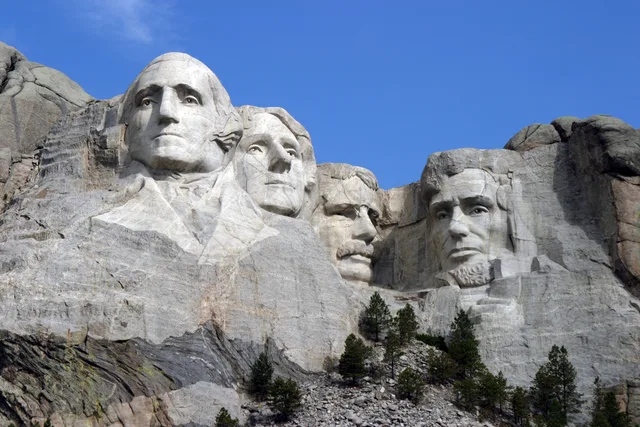

After a day of driving, we are in South Dakota, the state of presidential heads. Although we subconsciously understood that these heads aren't exactly a mind-blowing wonder, perhaps due to the impression left by Yellowstone, we were met with confusion and disappointment upon arrival. Well, no, not disappointment (after yesterday, that's unlikely), but a complete lack of emotion regarding today. 12 dollars per person at the entrance to the Mount Rushmore monument (per person, not per car—a first for us in the USA) for an alley with state flags and 4 not-very-well-drawn heads. It's not that I begrudge the money, but there was definitely a feeling of slight confusion, like when you're expecting a date and her dad shows up instead)) In terms of austerity, narcissism, and atmosphere, it resembles fascist Alleys of Glory or Stalin-era avenues. You can definitely feel the era. We figured we just didn't understand this place (quite sincerely) and drove further south. There are several other such sculptures in the rocks there, like the Crazy Horse Memorial or others. It's simple here—we look from the road, check the box next to Rushmore, and drive further south. Where were we so stubbornly heading, off our route to Chicago, you ask? We didn't even know ourselves. Dakota was home to the first national parks we knew almost nothing about: Wind Cave and Badlands. Badlands, as it turned out later, is a local copy of some canyon (though quite decent, if you have time, stop by), but Wind Cave is something else entirely... It was about 4 PM. We had driven through probably 3/4 of Wind Cave park, but hadn't even noticed any sign of the mountains where our caves might be located. We almost hit the third animal of the day (the first was a fawn we barely swerved around in Teton while it was peacefully grazing on the road. The second was a rabbit crossing the road at night on the way from Wyoming. Again, we swerved, but I still can't understand how I managed to keep the car from kissing the ditch at 170 km/h:))). But this deer also remained intact, and we, incredibly happy about it, pulled up to the Visitor Center. It turns out there were 10 minutes left until the last tour of the day. We met the best guide in the world here. I don't know what this cave would have looked like without him, but with him, it was the most interesting place on the planet during those 2 hours of the tour. There is only one entrance to the cave—a 20 by 10 cm hole hidden in the ground, which, due to the difference in air properties, creates wind and whistling, which is what the Indians noticed, giving the cave its name. The Indians thought spirits lived here and never visited the cave until a 16-year-old white boy found it... The entrance was located not far from the backyard of the boy's new house, and it was one of those cases where the place found its hero... Every day for 3 years, the boy would disappear there, carrying only a rope and candles... He did titanic work, mapping 22 km of caves. And he didn't even put all the places he knew on it. That's why our guide, who had gone with a group three weeks prior to discover new places, when he climbed into a grotto unknown to any scientists, discovered an inscription on the wall: "Alvin McDonald was here, November 19, 1893." No one knows where else this guy had been, and no one knows how much more he could have done, but less than a month after creating this inscription, he died of tuberculosis while traveling to see the President to ask for the Cave to be made a National Park. His request was granted... We enter through a specially built elevator—everything is very interesting, we look at halls and passages, sometimes insanely cramped, sometimes the size of a house, but it's all like a museum, we just walk and walk. Well, it's a cave. Camera flashes click, Japanese tourists walking right behind us laugh. Suddenly we reach a spot where the guide stops. "One day, Alvin disappeared in the cave for 3 days," the guide said. "No


 +2