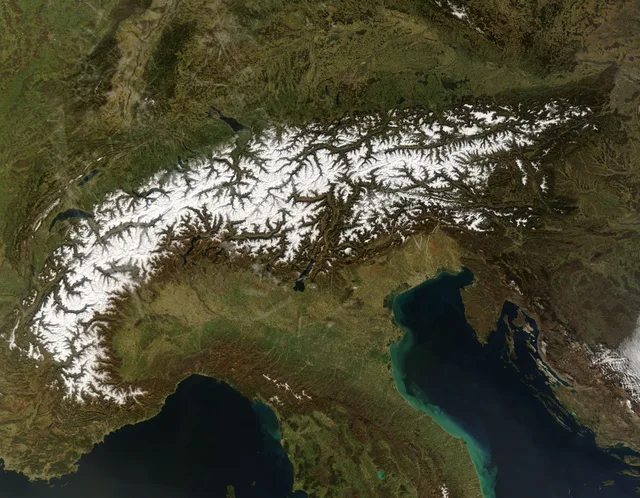



Following our intuition, we headed straight for the coast in Washington state. We wanted to meet the ocean in Seattle, the northeasternmost of America's major cities. But at the same time, we couldn't help but visit the Rocky Mountain National Park on our way. But first, a little about Washington state itself. Washington's nickname is the "Evergreen State." Entering it from the east for the first time, you're unlikely to feel that. Moreover, you're unlikely to see anything green at all. Absolutely bare and flat steppe, almost a desert with scorched, yellow-gray grass is the maximum you can count on. There are almost no modest villages on the way, but signs like "Next gas station 100 miles" are the norm in these parts. The only attraction I would name is the constellation of wind farms located on every hill. From afar, they seem like miniature fans capable of generating energy for at most one shed, but getting closer, you feel like an ant in front of a tree. Just one blade of such a unit can be about 40 meters long. And the entire structure of the station exceeds the height bar of 120-150 meters. Further on, the steppe begins to sway, forming smooth hills and wide gorges for quiet rivers. The amplitude of these swings increases until high mountains covered with forests and snow appear outside the window. Those are the Rocky Mountains, perhaps the highest part of the Cordillera in continental America (naturally, not counting Alaska). They are impressive, very picturesque, and reminded me of the Alps from the picture on the Alpen Gold chocolate bar that I had in my childhood. But after everything we had already seen, after the wonders of nature that the national parks of the last 6 days were for us, the Rocky Mountains seemed like something standard, ordinary, academic. In my opinion, this is exactly how mountains should look. Having agreed on this opinion, we simply crossed the park in about 20 minutes. Now, finally, we left the land of small towns, which I would call the Midwest and the mountain region, and drove onto Highway 5. A wide road, towns flowing into one another, and developed infrastructure amazed us again. We were so unaccustomed, so wild from all the benefits of civilization after the last week spent wandering through the fields and mountains of the West. Seattle greeted us with excellent weather, which is rare for the extreme northwest of the USA. It rains here almost every other day; huge traffic jams and urban traffic, which was so difficult for us. It was even funny when we first spent an hour looking for a legal parking space somewhere near the city center, and then gave up on everything and decided to brazenly park under a sign that said "For store customers only." In a big city, where the problem of a lack of free parking spaces is especially acute, this, in my opinion, is the most harmless and least risky way. After all, you must agree, no one will track where you went: to this very store or just in the other direction for your own business. Running ahead, I will say that, unaccustomed to such a flow of cars, we managed to break the rules a dozen times: at least twice we drove into the oncoming lane of a one-way street and at least three times we parked where we were not supposed to. Seattle is the most laid-back city in the states; there are more freaks here than anywhere else. The atmosphere, lifestyle, and way of life characteristic of the West Coast are very vividly represented here. The cities are significantly larger in area and are designed for universal car use, especially since the width of the streets also contributes to this. Secondly, the changed ethnic composition of the population—after all, it is closer from China to the West Coast than to the East. Asian diasporas are the oldest and have the greatest influence not only in the city but also in all nearby states. The headquarters of "new," "modern" enterprises are located here, be it Amazon or the sensational MicroSoft. Novelty is present in e


 +2