

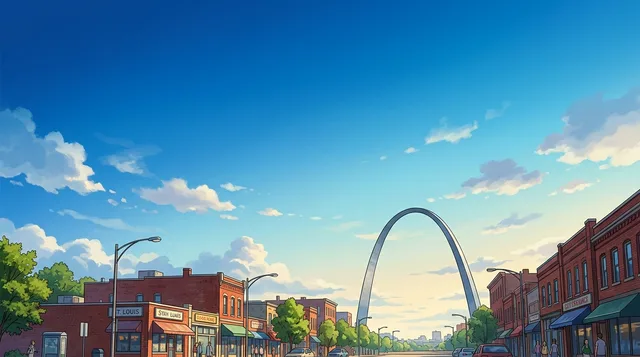
I really didn't want to leave Key West, but all good things come to an end sooner or later. We had 34 hours on a bus ahead of us to get to St. Louis. To be honest, I hadn't planned on visiting this city, but crossing all of America from east to west without stopping would have been simply impossible. We arrived early in the morning and the first thing we did was run to the restroom to wash up. Although "wash up" is a bit of an exaggeration! If you manage to brush your teeth and wash your hair, that's already a blessing. Yes, you heard that right, I said wash my hair. Washing your hair in a sink and then drying it under a hand dryer isn't the most fun activity, but we simply had no choice. However, these are just minor inconveniences. We didn't really like the city much; we made it to the main attraction – the Gateway Arch – a huge arch on the banks of the Mississippi that symbolizes the gateway to the West. We walked around the parks a bit, took photos of the famous Route 66, and got back on the bus. All in all, we spent no more than 6-7 hours in St. Louis.
St. Louis: Travel guide, prices and free housing · 2026
Newcomers need a car to manage daily routines, as neighborhood safety and amenities shift abruptly across Delmar Boulevard.
- 1 day
- Gateway Arch, Downtown, Laclede's Landing
- 3 days
- + Forest Park, Central West End, The Hill
- 7 days
- + Soulard, Lafayette Square, Cahokia Mounds
St. Louis operates as an independent municipality separate from its surrounding county, creating distinct civic boundaries and stark neighborhood contrasts.
The city functions entirely apart from the surrounding county, maintaining separate municipal services and taxation. Residential life clusters into architecturally distinct pockets, ranging from the red brick masonry of Soulard to restored townhouses around Lafayette Square and adapted commercial warehouses downtown. Because bus routes run infrequently and taxis cannot be hailed from curbs, newcomers depend on cars.
Read on
Healthcare and scientific research dominate the employment base, anchored by the Washington University School of Medicine and Barnes-Jewish Hospital. Nearby in Midtown, the Cortex Innovation Community gathers biotechnology firms and software offices into a dense technology district. The MetroLink light rail system connects these research facilities directly to downtown, providing reliable transit along that central corridor.
Ancient Mississippian earthworks earned the settlement its long-standing nickname of Mound City, while immigrant arrivals established idiosyncratic food traditions. Daily dining features regional items like toasted ravioli, thin crust pizza topped with Provel cheese, and gooey butter cake. Sharp economic segregation persists along the urban grid, leaving northern neighborhoods under severe disinvestment and elevated risk.
- Gateway Arch
- Toasted ravioli
- Cortex Innovation Community
- Delmar Divide
- Soulard
- The municipal government operates independently without belonging to any county jurisdiction.
- Cathedral Basilica of St. Louis contains the largest collection of mosaic art in the world.
- The Washington University School of Medicine partners with Barnes-Jewish Hospital to anchor regional medical care.
- Sugarloaf Mound in South St. Louis was repatriated to the Osage Nation.
Getting there and staying
Flight, airport, hosts and rent
No free-housing hosts here yet.
- 01Connect to the terminal wireless network or set up mobile roaming.
- 02Withdraw local banknotes from an airport terminal automated teller machine.
- 03Board the MetroLink Red Line train at the airport station toward downtown.
- 04Check into your lodging and leave your baggage.
2 sources · As of September 18, 2026
Visa and practicalities
Choose a passport
Set your passport — processing time, fee and documents differ between passports.
Internships, au pair and study programmes have a different visa category and a different set of documents. Applications go through CMO International Programmes.
IEC international programmes- Taxicab drivers are prohibited by municipal regulations from soliciting passengers.
- Regulations require taxicabs to use taximeters and accept cash or credit cards.
- Taxis rarely pick up street hails, requiring riders to arrange trips by telephone or mobile software.
1 more rule
- Travelers should verify taxi credentials because uninsured passenger vehicles have operated locally.
How do I get from the airport to downtown St. Louis?
MetroLink light rail connects Lambert St. Louis International Airport directly to the city center via the Red Line. Ride-hailing services and taxis also operate from the airport terminal. Gateway Multimodal Transportation Center downtown serves as a transfer point for regional rail and buses.
Source: Wikipedia · Wikivoyage · WikivoyageWhat public transit options exist in St. Louis?
The Bi-State Development Agency operates MetroLink, an electric light rail network with the Red Line and Blue Line serving central and suburban districts. A local bus network called MetroBus provides additional connections across the metropolitan area. The lines converge downtown at the Gateway Multimodal Transportation Center, which also links to intercity passenger trains.
Source: Wikipedia · WikivoyageWhat food specialties is St. Louis known for?
Regional dishes include toasted ravioli, thin-crust St. Louis-style pizza topped with provel cheese, and gooey butter cake. Diners also serve the slinger, which combines breakfast staples under chili, alongside distinct local creations such as the St. Paul sandwich. Frozen custard shops also serve thick blended desserts known as concretes.
Source: Wikipedia · WikivoyageWhich neighborhoods are best known for dining and nightlife?
The Hill is the traditional center for Italian dining, packed with trattorias and bakeries. The Delmar Loop offers sidewalk cafes, music venues, and eclectic restaurants. For evening drinks and entertainment, popular corridors include the Central West End and Washington Avenue downtown.
Source: Wikivoyage · WikivoyageWhat should visitors know about safety in St. Louis?
Crime rates vary considerably across different parts of the metropolitan area. Frequently visited districts such as Downtown, Forest Park, and the Central West End maintain active patrols and lower incident rates. Visitors should observe standard urban precautions, monitor neighborhood surroundings, and review local tornado safety guidelines during storm seasons.
Source: WikivoyageWhy is St. Louis called the Mound City?
Before European colonization, the surrounding river valley was a major hub for the Mississippian culture, which constructed large ceremonial earth mounds. Most of the earthworks within the municipal boundary were demolished during later urban construction. The regional core of this culture survives nearby at Cahokia Mounds.
Source: Wikipedia2 sources
Safety and health
Official travel advice and the medical minimum
Getting here
Airports, distances and public transport
When to go and itineraries
When to come and what fits into a day, three days and a week
- 09:00Gateway ArchWalk through Gateway Arch National Park along the Mississippi River.
- 11:30Old CourthouseVisit the historic courthouse where the Dred Scott case was argued.
- 13:30Laclede's LandingWalk cobblestone streets near the river for lunch in converted brick warehouses.
- 16:00St. Louis Union StationInspect the historic grand terminal hall, now adapted as a hotel and arcade.
- 10:00Cathedral Basilica of St. LouisExamine the extensive interior mosaic installation.
- 12:30Central West EndWalk tree-lined streets near Euclid Avenue for lunch and local cafes.
- 15:00Delmar LoopBrowse independent retail and music venues along this pedestrian corridor.
People who have been here


Stay longer on a programme
Work and Travel, internships, au pair and volunteering in United States: visa, invitation and on-site support are handled by CMO International Programmes.

Cities of United States
Places in St. Louis
Countries nearby
Frequent questions about St. Louis
Can’t find the place you need? Search understands any language. Open search