
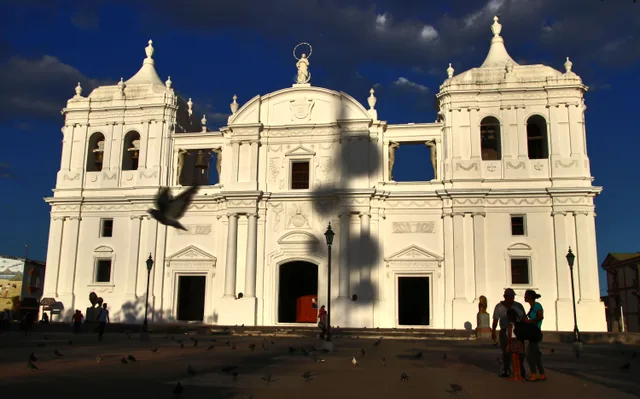
 LeónLeón Cathedral
Explore
Nicaragua: Travel guide, visas and free housing · 2026
Commuters cross town between separate market bus terminals to catch regional microbuses. Long-term residents rely on neighborhood fritanga grills for hot meals and keep local cash ready for daily transit.
Now in the cityNicaragua
EntryPick a passport
Places on the map24Exchange rateC$36.81as of Nov 2, 2026
Language on siteSpanishHighlights of the country
- Caribbean coast
- English, Spanish, and indigenous languages
- Pacific and central regions
- Spanish
- Public markets and bus terminals
- Spanish
«¿Cuánto cuesta?» — Use when purchasing goods in open markets or confirming transport fares.
About the place
Volcanic terrain, distinct coastlines, and cash-based transport shape daily routines across the territory.
The territory divides culturally between distinct coastal regions. The Pacific side contains historic colonial centers such as Granada on Lake Nicaragua and León near Lake Managua, where Spanish and mestizo traditions dominate. Along the Caribbean coast, British protectorate history left an English-speaking population alongside Miskito, Rama, and Mayangna communities who maintain native languages.
Read on
Public transport relies on repurposed school buses and regional microbuses departing from specialized market stations in Managua, including Mercado Israel Lewites and Mercado Huembes. Commuters pay in cash, as electronic ticketing is unavailable. Daily dining centers on street-side fritangas serving gallo pinto, thick corn tortillas with quesillo, and traditional nacatamales steamed in banana leaves.
Agriculture drives the domestic economy, with northern highlands around Estelí producing coffee and export tobacco, while smallholder farms harvest recognized fine cocoa. Practical living requires local córdobas for small vendors and pulperías that charge deposits on glass bottles. Urban drivers keep car windows rolled up in traffic jams to prevent opportunistic theft at street intersections.
Associations
- Gallo pinto
- Fritangas
- Marimba
- Street crime
- Fine cocoa
Facts
- Managua operates multiple distinct long-distance bus terminals that serve specific geographic regions.
- The Caribbean coast maintains an English-speaking heritage from its era as a British protectorate.
- The International Cocoa Organization recognizes domestic cocoa production as fine flavor origin.
- Traditional marimba performers play the instrument on their knees accompanied by acoustic string instruments.
Source: Wikivoyage · Wikipedia
Nicaragua in pictures9 photos
Visa and practicalities
Choose a passport
Set your passport — processing time, fee and documents differ between passports.
Good to know
- Exit fees at land border posts cannot be paid in local currency.
Frequently asked
What are the main staple foods to expect in Nicaragua?
Daily meals typically center on rice and beans, often accompanied by meat, cheese, or fried plantains. Street food stalls known as fritangas serve grilled meats, while regional specialties include nacatamales wrapped in banana leaves and quesillo tortillas filled with cheese and cream.
Source: WikivoyageHow does public transportation operate between cities in Nicaragua?
Repurposed school buses handle most long-distance routes between major towns and depart from designated market terminals in the capital. Travelers looking for faster transit between nearby settlements can use minibuses, though vehicles on both networks frequently travel fully packed.
Source: WikivoyageWhat cultural and linguistic differences exist between the Pacific and Caribbean coasts?
The Pacific region has a predominantly Spanish-speaking mestizo population shaped by Spanish colonial heritage. By contrast, the Caribbean coast retains British cultural influences, where English and indigenous languages are spoken alongside Spanish by distinct communities.
Source: WikipediaWhat traditional beverages are popular in Nicaragua?
Popular non-alcoholic drinks include traditional grain and cocoa mixtures like pinolillo as well as fresh fruit juices blended with water or milk. Domestically produced rum such as Flor de Caña and local lagers are the standard alcoholic choices.
Source: WikivoyageWhat safety precautions are recommended for transit and rural travel?
Travelers are advised to avoid walking alone after dark and close taxi windows in heavy urban traffic. In northern rural zones, visitors should remain on marked main roads due to residual landmines remaining from past conflicts.
Source: WikivoyageAre plastic bags permitted when entering Nicaragua?
Plastic bags are prohibited under national environmental rules. Airport customs officials inspect incoming luggage and confiscate all detected plastic bags, including bags acquired from duty-free retailers.
Source: WikivoyageWhat is the capital city of Nicaragua and how is it connected to the country?
Managua serves as the national capital and hosts the primary international airport for incoming flights. The city operates several regional bus terminals that link the capital with the Pacific coast, northern highlands, and southern borders.
Source: Wikidata · Wikivoyage · WikivoyageSafety and health
Safety · official adviceour data as of Nov 3, 2026
Plastic bags are banned nationwide, and airport officials confiscate them from incoming luggage.
Foreign nationals are prohibited by law from participating in domestic politics.
Authorities may inspect personal luggage and electronic devices at checkpoints and border crossings.
1 more risk
Rural northern areas off paved roads carry a danger of unexploded landmines.
Source: UK FCDO Foreign Travel Advice · US Department of State Travel Advisory · Wikivoyage · Wikivoyage
Language and culture
Five phrases for the first day and where you can’t do without the language
Spanish is essential for daily life across most of Nicaragua. English is widely spoken along the Caribbean coast due to regional history, as well as by select staff at major international hotels and travel agencies.
Five phrases for the first day
- ¿Cuánto cuesta?KWAN-toh KWEHS-tah
- Sin hielo, por favor.seen YEH-loh por fah-VOR
- Agua purificadaAH-gwah poo-ree-fee-KAH-dah
- ¿Tiene cambio?TYEH-neh KAHM-byoh
- ¿Tiene habitaciones en alquiler?TYEH-neh ah-bee-tah-SYOH-nes en ahl-kee-LEHR
2 more phrases
- La cuenta, por favor.lah KWEHN-tah por fah-VOR
- Necesito ayuda, por favor.neh-seh-SEE-toh ah-YOO-dah por fah-VOR
Where you will need the language
| Situation | Language |
|---|---|
| Caribbean coast | English, Spanish, and indigenous languages |
| Pacific and central regions | Spanish |
| Public markets and bus terminals | Spanish |
| International airline counters and large hotels | English and Spanish |

LanguageFree
Spanish from Scratch: A0 → A2StudyHub· ≈ 65 hours
People who have been here

...the airport was left far behind. In the shuttle, I meet two Cubans (or rather, they meet me...) ah, Cubans... more on that later..;) In broken English, they ask where I'm from, I say Belarus.. Belarus? Never heard of it.. The rest of the way they talk among themselves in Spanish, and one by one, first the driver and then other passengers on the "shuttle" join in.. soon the whole shuttle bus knows each other by name, everyone is laughing merrily, making jokes (judging by the glances, in my direction..) oh yes, in Spanish, of course! By the way, I came to the USA with a firm intention to improve my English, but instead, it seems I'll have to learn Spanish.. In Miami, 90% speak Spanish, it's all Latinos: Cuba (this is apparently that 90%=)), Honduras, Nicaragua, Dominican Republic, Mexico, Ecuador, Colombia, Portugal, Jamaica... but the Cubans! There are tons of Cubans! A wide selection, a rich assortment.. =) In short, you could say I wasn't in America, I was in Cuba=)) ...meanwhile, our little bus reaches Miami Beach, new acquaintances gradually get off, saying goodbye to those remaining in the "shuttle" as if they had known them their whole lives or had been best friends for an eternity! Extremely friendly people!! Here is my hostel, I pay the driver, get a few invitations to visit from the passengers as I leave, turn on my default "smile and wave" (it's amazing, but it works!! An extremely useful thing) and tired but happy, I trudge to the reception.. ..reception: hello, I would like.. no, I don't speak Spanish.. yes, my friend booked a spot for me in room #11.. no, I don't have luggage, it was lost.. I get a magnetic card, and here I am in the room... Nadya (that's my friend's name) is at work.. in the room, judging by the occupied beds, there is one more person besides us.. the setting doesn't match the $27 paid: two bunk beds, a small refrigerator without a leg, one closet for three, a shower.. air conditioner right above the bed, impossible without it, but with it - it blows.. just as I'm about to take a shower, the door opens and.. - here it is, the wonderful moment of reunion!! Nadya was let off early! We rejoice, exchange impressions.. I tell her about the lost luggage, we need to go shopping immediately.. Here we are at the store. By the way, stores in Miami Beach are divided into two types: very expensive branded ones and, no less expensive, souvenir ones, where you can buy wonderful panties with no less wonderful inscriptions ("FBI - fabulous booty inside" - the most decent of what was there), as well as t-shirts-bikes-caps-towels-shorts with screaming, no, YELLING declarations of love for Miami itself and for each of its parts individually! I love Miami! I love South Beach! I love Miami Beach! I buy shorts.. next, I need shoes.. AirFrance is paying! We go into the first shop.. And here we meet for the first time... a guy trying on stilettos.. he is keenly interested if they have the same ones, but in black.. he also likes the red ones very much, but he is more comfortable in black, it's not (!) as provocative.. yeah.. we go into a couple more shops, quickly buy everything necessary - and back to the hostel, I am terribly exhausted, the night at the airport and the time difference are taking their toll.. tomorrow we have a day off, the owner (from the restaurant) promised to take us around the shops

Cities of Nicaragua
Places in Nicaragua
Can’t find the place you need? Search understands any language. Open search