
- 距离
- 3.3公里
巴尔赫 · 阿富汗
纳婆毗诃罗国: 周边有什么、如何前往、何时最合适 · 2026年
Field researchers working near ancient ruins navigate remote desert conditions and restricted site access across the northern plain, relying on local community clearance for long archaeological seasons.
周边推荐1
关于此地
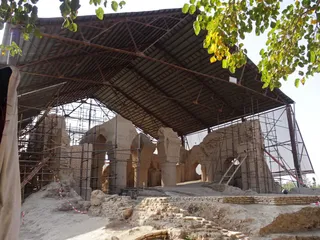
Nava Vihara represents a major historic monastery complex that anchored regional Buddhist learning.
Pilgrims and historical scholars recorded the monastery complex near Balkh as a prominent institution of Sarvastivadin Buddhist learning. Historical documentation describes a draped central stupa platform where devotees performed ritual circumambulation and prostration. Travellers from distant regions visited the academic sanctuary to study alongside resident scholars during eras of active pilgrimage across Central Asia.
继续阅读
Regional conflicts repeatedly disrupted the sanctuary, prompting waves of monks to seek refuge in Khotan and Kashmir. Hereditary administrators from the site later integrated into imperial governance as viziers under the Abbasid Caliphate. Subsequent observers and writers recorded surviving monastic wall frescoes, while some regional chronicles mistakenly classified the compound as a Zoroastrian fire sanctuary.
相关组织
- Barmakid dynasty
- Sarvastivadin scholarship
- Conflict and displacement
- Bactrian stupa architecture
事实信息
- The monastery functioned as a major Sarvastivadin center of Buddhist learning visited by the Chinese pilgrim Yijing.
- Hereditary administrators from the monastery later served as powerful viziers under the Abbasid Caliphate.
- Writers recorded that the central stupa platform was draped with veneration cloths and circumambulated by devotees.
- Persian scholar Al-Biruni noted that Bactrian monasteries including Nava Vihara retained visible Buddhist frescoes.
交通与住宿
2 个来源 · 截至 2026年11月4日
来源:TravelHub · OurAirports (public domain)


没找到心仪的目的地?搜索功能支持任何语言。 打开搜索