
- 距离
- 600米
塞拉耶佛 · 波斯尼亚和黑塞哥维那
國立波士尼亞與赫塞哥維納博物館: 周边有什么、如何前往、何时最合适 · 2026年
Long-term researchers spend entire mornings moving between unheated pavilion archives and separate department reading rooms across the central courtyard.
关于此地
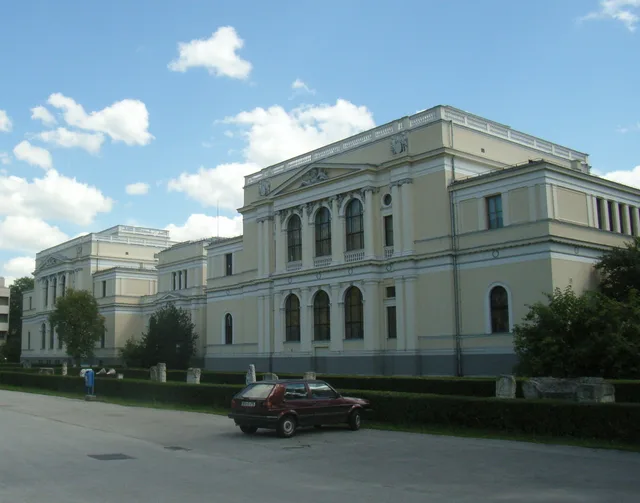
Separate neoclassical pavilions house the primary archaeological, ethnological, and natural history records of the territory.
Austro-Hungarian authorities established the institution after early Ottoman proposals stalled. The administration designed the complex around distinct pavilions housing archaeology, ethnology, natural sciences, and a specialized library. Curatorial growth initially centred on scientific field collections under Kosta Hörmann.
继续阅读
Interwar administrative centralisation reduced state funding and curatorial maintenance for the collections. Postwar socialist governance subsequently revived the scientific agenda, expanding publishing departments and youth research programmes. Later military bombardment inflicted severe structural damage on the compound.
Scholars working across the departments must navigate separate detached buildings rather than a unified space. Historical collections cover regional archaeology, folklore, mineralogy, and botany across surviving galleries. Ongoing preservation addresses structural vulnerabilities caused by wartime shelling and past neglect.
相关组织
- Pavilion layout
- Wartime structural damage
- Kosta Hörmann
- Natural history collections
事实信息
- The institution was conceived under Ottoman administration and officially established during Austro-Hungarian rule.
- The complex divides its collections across separate departments for archaeology, ethnology, natural history, and a library.
- Artillery fire during wartime caused severe structural damage to the roofs, gallery walls, and windows.
- Kosta Hörmann served as the inaugural director, overseeing initial collection growth.
國立波士尼亞與赫塞哥維納博物館 的影像6 张照片 · 2 个地点
交通与住宿
机票、机场、房东及租房
此处暂无免费住宿的房东 — 最近的此类城市为:
威尼斯2 个来源 · 截至 2026年9月22日
来源:TravelHub · OurAirports (public domain)
周边相似目的地
预算相似且邻近 國立波士尼亞與赫塞哥維納博物館 的目的地
- 距离
- 900米
- 距离
- 1.5公里
没找到心仪的目的地?搜索功能支持任何语言。 打开搜索